9.14.2557

Japan's Mitsubishi Corp says may invest in Indonesia auto plant

(Reuters) - Japan's Mitsubishi Corp is considering investing in a new car factory in Indonesia with its partners, the trading house said, as the country seeks to lure investments into manufacturing and reduce its reliance on volatile resources.
Mikio Sasaki, Mitsubishi Corp's senior advisor, met Indonesian president-elect Joko Widodo this week, a company spokesman said on Wednesday, adding that nothing had been decided yet.

Widodo, who will take office in October, is expected to bring in much-needed reform for business in Indonesia.
Indonesia's investment authority wants to attract more foreign investment into manufacturing and other value-added industries to wean the economy off the volatile resources sector, its chairman told Reuters last week.

Mitsubishi Motors Corp, owned 10.1 percent by Mitsubishi Corp, had previously said it may build a new plant in Indonesia. Its chief executive will visit the country next week, an individual familiar with the matter said.

The automaker currently manufactures commercial vehicles at a plant in Jakarta owned by Mitsubishi Corp and local partners.

"We are still considering (investing in a new plant) in a positive manner," a Mitsubishi Motors spokesman said.

Several companies from countries including Japan have expressed interest to invest in the automotive sector, Mahendra Siregar said, as Indonesia is set to overtake Thailand as Southeast Asia's biggest car market.

"The medium term plan of these manufacturing companies looking at Indonesia is producing close to 3 million cars by 2020 (from around 1.3 million this year)," he said.

"I think that is regardless of what happens in other countries because that would be a good combination of, let's say, 75 percent domestic and 25 percent exports."

The Jakarta Post reported earlier on Wednesday that Mitsubishi Corp may invest up to $1 billion to boost its Indonesian automotive business. The company spokesman said the $1 billion amount was incorrect. (Reporting by Yoko Kubota and Eveline Danubrata; Additional reporting by Yayat Supriyatna in JAKARTA; Editing by Elaine Hardcastle)

11.23.2556

Eco-friendly car focused Tokyo Motor Show opens

The Tokyo Motor Show kicks off Wednesday with Japanese automakers showcasing their latest electronic technology and eco-friendly cars aimed at the growing low-emissions sector.
   The biennial event, which runs until December 1, will feature domestic makers of passenger cars, commercial vehicles and trucks alongside most of their European competitors.
   A total of 177 exhibitors, including parts suppliers, from a dozen countries are taking part in the event's 43rd edition.
   But US-based automakers, which have not attended since before the global financial crisis, are staying away again, as are South Korean producers, with the exception of Hyundai.
   Toyota, the world's biggest automaker, will be among the major firms at the show after recovering from a series of crises in recent years, including the global financial meltdown, Japan's quake-tsunami disaster and the safety recall of millions of vehicles.
  The big European automakers will be looking to boost their presence in the world's third-largest car market after China and the United States.
  However, foreign brands hold a miniscule share -- just 4.5 percent -- of a market that saw more than 5.0 million vehicles sold in Japan last year.
  That puny presence has long stoked anger among US and some European automakers, which say they have been effectively shut out of Japan through tariffs and other barriers. The simmering issue is a key obstacle in ongoing free-trade negotiations.
   Luxury German brands including Mercedes-Benz, BMW and Porsche, which have seen significant success in Japan, will be among this year's attendees, along with Audi, Volkswagen, Renault, Peugeot-Citroen, Britain's Land Rover and Sweden's Volvo.
  The show will focus heavily on high-tech offerings and environmental technologies as firms look to tap the burgeoning green-vehicle sector, seen as the next evolution of the global automotive industry.
  A pioneer of hybrid cars, Toyota is set unveil its latest fuel-cell concept car, with an expected commercial rollout two years away.
  The four-seater sedan has a range of 500 kilometres (310 miles) -- longer than previous versions -- and can be recharged in just three minutes through hydrogen gas tanks stored inside the vehicle.
  Fuel cell vehicles are considered the holy grail of green cars because they emit nothing but water vapour from the tailpipe and can operate on renewable hydrogen gas.
  Toyota's concept vehicle seeks to jump two key hurdles that analysts say have hindered consumer buying of eco-friendly cars, including electric vehicles -- range and re-fuelling infrastructure.
Relatively high prices have also dented demand.
However, purchases of low-emission vehicles are forecast to grow, with further technological advances in the field seen as crucial due to toughening emissions standards.

11.17.2556

Ford opens first dealership in Yangon

YANGON - Ford Motor Co officially opened its first authorised dealership in Myanmar Friday, joining a rush to set up shop in the former junta-ruled country as the West rolls back sanctions.
A hostess poses for photographs during the official opening of the Ford Motor Co's first authorised dealership in Myanmar at the Ford Motor Showroom in Yangon on Friday. (EPA photo)
Despite price tags beyond the reach of many in the impoverished nation, the US auto giant said more than 1,500 customers had already visited the showroom since its ``soft launch'' two months ago.
Myanmar's population of 60 million and growing demand for cars ``excites us``, said Ford regional manager David Westerman.
``That's what is going to create that growth in the coming years and decades ahead,'' he told reporters.
Foreign investors are eagerly eyeing the resource-rich country following dramatic political and economic reforms since military rule ended in 2011.
Huge import taxes and international sanctions aimed at the previous regime had meant vehicles were too expensive for most people, but recent changes have seen a sharp increase in demand for four wheels.
Many cars on the roads in Myanmar are second-hand imported Japanese vehicles.
New imported cars remain expensive, with the US-made Ford Explorer starting from $105,000 (3.25 million baht).
The Thai-made Ford Single Cab Ranger, which is classified for commercial use and therefore not subject to the same level of import taxes, has a price tag of $22,000 and upwards.
Foreign auto makers are also looking to set up manufacturing facilities in the country.
Japan's Nissan Motor recently unveiled plans to launch production in Myanmar with its Malaysian partner Tan Chong Motors, following in the footsteps of Suzuki.

Credit by Bangkok post

11.10.2556

Chevrolet posts slight increase in October car sales

Chevrolet sold 7,502 vehicles in Southeast Asia in October , representing a slight increase from September, as the carmaker continued to grow its market share in countries like Indonesia and Philippines, according to a company statement.

Chevrolet sales in the Philippines surged by 38 per cent during the month - a 66 per cent increase year-on-year with a total of 499 units sold - making October the highest- performing month in the brand’s history in the country.

Trailblazer led sales with 274 units, continuing its leadership in the country's SUV segment.

Chevrolet Indonesia sold 2,351 units in the month - a 30 per cent increase from September and a 490 per cent surge compared to the same month last year. The Spin continued to lead sales with 1,680 units, a 20 per cent rise from September.

The carmaker sold 4,231 vehicles in Thailand in October, led by the popular Colorado ( 1,956 units) , and 1,204 units of Sonic. Other models that contributed to a steady sales performance were the Trailblazer (406 units), Captiva (343 units), Cruze (180 units) and Spin (130 units).

"We continue to see a positive trend in Chevrolet’s market share throughout the region in the midst of what is probably the most competitive environment we’ve seen in a long time," said Gustavo Colossi, Vice President of Sales, Marketing and Aftersales, Chevrolet Sales Thailand and GM Southeast Asia Operations.

" We are particularly pleased with our performance in Indonesia and the Philippines with record-breaking growth due to popular models like the Trailblazer and the Spin," he said .

"Thailand continues to be a very competitive environment across the entire auto industry in all car segments. Chevrolet is confident that our fresh product line-up, combined with our innovative incentive programmes, will continue to attract new customers to the Chevrolet brand," he added.

Chevrolet recently announced the new ’Five-Year Worry Free’ campaign - a five-year maintenance-free campaign for the popular Cruze model, demonstrating Chevrolet’s commitment to customer service and satisfaction.
 
Credit by Thaiauto

3.07.2556

Geneva 2013: Four of the Best


This year's Geneva Motor Show is now in full swing, and having just returned we can vouch that power was the order of the day. Lamborghini, Ferrari and McLaren revealed new hypercars with the Veneno, P1 and La Ferrari models respectively, and there were a number of more reasonably priced hot hatches for the rest of us, particularly the Volkswagen Golf GTI and Kia Procee'd GT.
Although there was no green pavilion this year and pure electric cars were few and far between, environmental technology was incoporated into cars from almost every manufacturer, from the aforementioned hybrid supercars all the way to plug-in and natural gas versions of the Audi A3 and an updated Nissan Leaf. If fear of scaring buyers with avant-garde design is keeping the form of cars traditional, then at least the fear of emissions regulations and rising fuel prices mean that conventional drivetrain technology is getting cleaner and cleaner.
Here are four of our favourites from this year's show.


Volkswagen XL1
The most famous 1-litre car finally made its production debut at Geneva, and alongside its hybrid powertain huge advances have been made in decreasing weight and increasing aerodynamic efficiency. Shorter than a Polo and lower than a Porsche Boxster, the tiny XL1 is designed to move under as little energy as possible whilst maintaining high levels of safety and design.
Lightweight – At the heart of XL1 sits a carbon-fibre reinforced polymer (CFRP) monocoque weighing just 89.5kg. Whereas a conventional car’s body accounts for around 40% of overall weight, the XL1’s CFRP shell contributes only 29% of a total of 795kg. Polycarbonate windows weigh 33% less than glass ones and add only 5.2kg, whilst offset seats constructed from the same polymer as the body weigh half what a conventional seat would.
Aerodynamics – The impact of frontal drag on a car’s fuel efficiency is enormous, and whilst Mercedes are understandably proud of the new CLA’sdrag coefficient of 0.22 (a large-scale production car record), the XL1 counters with a Cd of just 0.19 (but a swimming penguin as a Cd of 0.03). To create a shape that offers the lowest resistance and maximum streamlining, the XL1 features a round front, a smooth roof, a strongly sloping and narrow rear as well as the removal of conventional wing mirrors, which have been replaced with cameras. Extreme measures for most cars, but the XL1 is nothing if not extreme.
Further modifications include a housing for the rear wheels and the specification of narrow tyres. Air vortex generators on the front wheels “prevent the air stream from getting caught in the wheels housing” and an attica (a groove below the rear lights) reduce air resistance further.


Toyota i-Road Concept
Toyota’s environmental strategy can be split into three bands. Mid to long-distance travel will be undertaken in hydrogen vehicles such as the FCV concept; hybrid and plug-in hybrid vehicles will be used for the majority of everyday journeys, with no range anxiety or burden to the infrastructure, and finally, electric vehicles will cover short distances. The i-Road concept for personal mobility fits nicely into the latter category.
Powered by a pair of 2kW motors mounted inside the front wheels, the i-Road has a range of 50km (when travelling at a fixed speed of 30kph) and can fully recharge from a standard 120V socket in three hours. So far it doesn’t’ really rival the similarly tandem-seated Renault Twizy, but what makes the i-Road interesting is the “entirely intuitive” Active Lean technology, which calculates the required lean angle based on steering angle, gyro-sensor info and vehicle speed before motors and gearing then forcibly tilt the i-Road. The Active Lean technology moves the wheels up or down initiating a lean to counteract centrifugal cornering forces. More simply, if you’re driving along a slope or cornering hard the i-Road will remain upright.
A hard top means no helmet is required, whilst a turning circle of three metres and quick charging make the i-Road ideal for personal urban transportation.


Kia Provo Concept
Kia’s catering to European tastes took another step forward with the B-segment Provo Concept – a confident, muscular hatchback with a small footprint. One of the aims for the exterior design was to find a new language between sculptural and product design, and wrap-around front and rear light graphics aim to emphasize the car’s width.
The Provo is a concept in the traditional sense of the word and the headlight band is made up of over 1,500 LEDs. A driver would even be able to upload personal designs via USB.
The Provo uses a four-cylinder 1.6-litre engine tuned to 204PS mated to a small electric engine, which during hard acceleration allows the concept to become temporarily four-wheel drive. It also permits the Provo to move exclusively under electric power at low speeds.
Amongst plenty of quilted leather, the interior philosophy is one of simplicity. “People are very busy in their minds and they have a lot to think about as well as the road, and we want to make our cars simple for the user and easy to maintain. We also want to bring fun and pleasure, but an affordable fun,” said Laurent Boulay, one of Kia’s Frankfurt-based designers largely responsible for the Provo.


McLaren P1
McLaren released a production version of the P1 hypercar, a pre-production version of which was seen at last year’s Paris Motor Show. A hybrid powertrain developing a combined power output of 903bhp gives the fantastically serpentine P1 a 0-300kph time of less than 17 seconds.
Materials have played a big part in the development of the P1, and whilst the majority of the car is constructed from high-quality carbon-fibre, much of the rear is wrought of titanium, principally for it’s heat-shielding properties.
The interior is as utilitarian as you could wish for, with no carpets unless they are specified, no sound-deadening materials and high-density but low-weight foam for the seats to reduce weight further. Not even the leather escapes intact, and any leather used is thinner than what goes into the ‘standard’ MP4. Furthermore, interior carbon-fibre is remains free of lacquer to save yet more weight (and reduce glare).
Although the P1 looks heavily CAD-rendered, Frank Stephenson insists the vacuum-packed design was the result of “a lot of sketching…all this talk of designing cars on computers is not really true.” Then next step after sketching is building 40% scale models before a full-size model is built from clay with five sculptors. Finally, the car went into the wind tunnel.

Credit by http://www.greencardesign.com

1.12.2556

Six upcoming diesel cars for 2013 in India

Though diesel fuel prices are set to rise considerably in 2013, it’s not stopping manufacturers from lining up many more diesel vehicles for you to choose from. Some of these are all new cars, while others are petrol variants that will finally also get a diesel option.

Here is a list of six cars for 2013 that will come with diesel engines. These cars are all in the sub-Rs. 10 lakh market, which is where the bulk of the action is.

Honda Amaze
honda-amaze-front-photo
The Honda Amaze compact sedan is one of the most looked forward to cars for the year. More so, because it will be the first Honda car in India to come with a diesel engine. Honda is going to launch the Amaze compact sedan, based on the Honda Brio in April 2013, and besides a 1.2 litre petrol engine, it will also have a 1.5 litre diesel engine that will be quite fuel efficient. The car will be tuned for fuel economy mainly, but initial reports from early drives in Japan suggest that the car is going to be pretty refined and fun to drive as well. Expect the Honda Amaze to be priced at about Rs. 5.5 lakh – Rs. 7.5 lakh when launched, with diesel variants on the higher side. The Honda Brio hatchback could soon follow the Amaze with a diesel engine as well, as the car has been spotted testing around the country.

Chevrolet Sail sedan
chevrolet-sail-sedan-photo5
Chevrolet is preparing to launch the Sail sedan in the next few weeks, as early as February. This car is the sedan version of the Sail U-Va hatchback that was launched in October. The Sail sedan is a replacement for the Chevrolet Aveo that was discontinued a few months ago. The Sail sedan is expected to be spacious, have good luggage carrying capacity and passenger comfort. It will come with a 1.3 litre diesel engine – which is GM’s version of the Fiat multijet engine (jointly developed by them nearly a decade ago). The Sail sedan may get slightly higher power of about 89 bhp, while it’s most likely that the car will come with a 77 bhp version first – the same as the Sail U-Va hatchback. Expect the Sail sedan to be priced between Rs. 6 lakh and Rs. 8 lakh.

 Ford EcoSport
ford ecosport suv photo
The Ford EcoSport’s strong point and unique proposition is going to be its petrol engine – the 1-litre, three cylinder EcoBoost engine. However, in a market where there is considerable demand for diesel, Ford is going to be launching the EcoSport in diesel as well, by end February. This compact SUV will come with a 1.5 litre diesel engine and five-speed manual transmission. The 1.5 litre diesel is the same as the engine used in the Fiesta and will put out about 90 bhp of power, but will be extremely fuel efficient – giving a fuel economy of 20 kmpl. For an SUV, that’s good!

 Mahindra Verito notchback
new-verito-front-photo
Continuing with the compact sedan fixation, Mahindra is shortening the Mahindra Verito to under 4-metres. This will allow the company to price the car aggressively as it will attract lower excise duties. The sub-4 metre Verito notchback will come only with a diesel engine – the same 1.5 litre K9K diesel putting out 65 bhp of power. This is an engine shared with the Renault-Nissan range of cars, and one of the most fuel-efficient engines in the market, second only to the Fiat 1.3 multijet. Expect the sub-4 metre Verito to be priced between Rs. 4.5 lakh and Rs. 5.5 lakh when launched in March this year.

 Hyundai i10 1.1 diesel
2014-hyundai-i10-front-left
Photo: Worldcarfans.com

Hyundai is planning to launch the new i10 in September this year with a diesel engine option as well. The company has developed a small capacity 1.1. litre diesel engine that will power a range of small cars. The Hyundai i10 is the first to get this engine and will compete with the Chevrolet Beat diesel and the Ford Figo diesel, as well as the upcoming Maruti Wagon-R diesel. The Hyundai i10 diesel is likely to be price about Rs. 1 lakh more than the petrol variant, giving it a starting price of about Rs. 4.6 lakh or so.

 Maruti Wagon-R diesel
maruti-wagon-r-face-lift-front-2013
The Maruti Wagon-R may be one of the first cars from Maruti to get a three-cylinder, 1-litre diesel engine similar to the one that powers the Chevrolet Beat. Fiat is developing the three-cylinder variant of the 1.3 litre multijet engine, which Maruti is likely to source and power a range of its small cars. The Maruti Wagon-R is the first candidate for this diesel engine, but there is no confirmation as to when the car will be launched. It will most likely come by the end of the year, and will have a starting price of about Rs. 4.3 lakh – competing directly with the Chevrolet

credit by cartog.com

1.11.2556

Detroit Motor Show 2013 Preview


Last year's NAIAS saw some exciting reveals at the COBO Centre in Detroit, including the latest iteration of Honda's hybrid NSX successor, Lexus' popluar LF-LC and a host of small urban-centric cars including smart's For-Us concepts and the Tata eMO. There's still plenty to come, but here's what to look forward to at this year's event.


Cadillac ELR
Detroit will see the world debut for Cadillac’s ELR luxury range-extender. GM have come good on their promise of production in 2013 following the Converj concept, which was unveiled at this show in 2009 and accurately previewed the ELR. The ELR is GM’s crucial second album in the range-extender category and is anticipated to use the same technology as the Chevrolet Volt, although the packaging will be more opulent and true to Cadillac’s current design language. Sharing tech with the Volt means an electric-only range of around 40 miles, although this could be extended to more than 50, and an overall range of over 300 miles with the help of the onboard four-cylinder petrol engine generator.
An overall investment of $561 million proves GM’s commitment to this kind of vehicle, and success is never guaranteed in unpredictable electric vehicle market. Striking looks will certainly help.


Mercedes CLA
Designed to exhibit an interplay between convex and concave surfaces, the CLA – previewed by the Concept Style Coupé at last year’s Tokyo motor show - is set to polarize opinion. Whether the aggressive yet organic lines appeal to you or not, there’s no doubting that the CLA is a statement of intent. The front graphic borrows heavily from the latest A-Class, a car that had over 70,000 pre-orders, suggesting that Gorden Wagener and his team know exactly what they are doing, whilst the car's profile matches its brief to sit just below the C-Class in Mercedes’ now extensive range. The CLA represents the culmination of an adventurous design strategy that has its roots in the F700 diesel hybrid concept revealed at the 2008 Frankfurt motor show and shows no sign of showing down. However, there’s no word of an electric CLA yet.


BMW 4 Series Coupé Concept
Mercedes won’t have the rakish coupé show to themselves, though, as BMW will exhibit an all-new car in their lineup – the 4 Series. Although a concept, it looks nearly production ready and pleasingly like a junior 6 Series. Pioneers of the modern coupé form, BMW seems to have nailed it here, with a wheelbase that’s 2 inches longer than the previous 3 Series coupé. The 4 Series is also noticeably lower and wider than its forebear. Strong facial features and a supple shoulder line give the 4 Series a composed and focused stance that’s aided by a softly sloping roofline. The 4 Series will go on sale with the traditional range of BMW engines, including the company’s brilliant two-litre diesel powerplant, but it’s easy to ponder what a car this would be with the i8’s hybrid drivetrain.


Via Motors’ Electric Trio
Via Motors specialize in giving people what they want in an environmentally friendly package. If you go onto the Via Motors website for example, you can preorder a 402bhp range-extender truck capable of 40 miles zero emissions driving with a deposit of $1000. Detroit will see Via debut three new vehicles – a high-performance 4WD pick-up capable of producing 800bhp, a luxury 4WD SUV and a twelve-seater van designed with shuttle routes in mind. By electrifying top-selling vehicles, Via Motors aim to reduce emissions to benefits the communities in which the vehicle work. Furthermore, in the event of an emergency, the electric generator can be used to power an entire household. Whilst is hard not to associate huge trucks with five-litre V8 engines (and they’re certainly not lightweight at over 5,000 lbs), try to think of these vehicles as super-sized Chevy Volts.


Hyundai HCD-14 Concept
Hyundai will build on the svelte, 'Fluidic Sculpture', lines of the I-oniq SUV concept unveiled at last year's Geneva motor show with this: a four door coupé designed in the same mould as Mercedes' successful CLS and, latterly, BMW's 6-Series Gran Coupé. Creatively dubbed HCD-14, Hyundai describe the car as a "glimpse into future Hyundai premium vehicle design, advanced 3-D gesture-based technology controls, and spirited driving dynamics". Head- and rearlamps are connected with a strong but supple bone line, whilst the real contour occurs in a secondary, softer feature line that runs just below. Like the CLS, the HCD-14 has an unusually high belt line which gives the car an athletic, sporty character, both from the outside and, due to a smaller DLO, from a passenger's perspective as well. Whether it will share the three-cylinder, electric-hybrid drivetrain found in the I-oniq remains to be seen, but expect low CO2 emissions either way.


Nissan Resonance Crossover Concept
Following in the footsteps of the dihedral hydrogen-fuelled TeRRA SUV concept at Paris, and more recently the EXTREM concept revealed at Sao Paulo, the Resonance is the latest in string of Nissan crossover concepts. From this image, however, the Resonance seems to be the most mature and resolved design yet from Shiro Nakamura and his team, with a radically kinked belt line that's integrated with a rear LED light graphic that quickly draws the eye. There's a good chance that the Resonance will offer a preview for a Murano successor, as the current model has already enjoyed a four-year production run. In typical concept fashion the car does without door handles and wing mirrors – expect large mirrors and door handles that are anything but invisible on a production version. Not forgetting a huge B-pillar as well, naturally.
 
Credit by Greencardesign.com

GM, Isuzu to discuss joint development of new truck


DETROIT/TOKYO: General Motors Co and Japan's Isuzu Motors Ltd will look at jointly developing a next-generation pickup truck, the automakers said, a move that could help cut costs and lessen the burden of technology development. 
The companies said in separate statements that they had signed a memorandum of understanding to start negotiations, but both declined to outline the timing of the talks or any other aspect of the potential deal. 

Japan's Nikkei business daily reported that the deal, which will also include co-management of their pickuptruck business, would be formalized late this month in a meeting between Isuzu President Susumu Hosoi and GM CEO Dan Akerson.
The newspaper also said the two companies will continue talks on the possibility of GM once again taking a stake in Isuzu, but an Isuzu spokesman dismissed the suggestion of capital ties.
"Currently, there is no possibility of an capital tie-up," the spokesman said. A GM spokesman declined to comment.
GM is seen as eager to tap Isuzu's strength in Southeast Asian markets and its diesel technology, while a deal for Isuzu means it could share the burden of developing technologies.
"Because the cost burden is big for Isuzu to develop engines, it probably sees it necessary to cooperate with someone, though it does not need a capital tie-up," said Kei Nihonyanagi, an autos analyst at BarclaysSecurities in Japan.
"By being able to sell engines to GM, Isuzu would be able to recover its investment easier."
The largest U.S. automaker first took a stake in Isuzu in 1971 and at one point owned as much as 49 per cent of the Japanese truck maker before selling the holding down. In 2006, GM sold its remaining 7.9 per cent stake for $300 million.
The companies, which worked together on trucks such as the GM Chevrolet Colorado mid-size pickup, sold as the i-Series by Isuzu, still cooperate in some areas. They jointly developed the updated Isuzu D-Max in 2011 and collaborate in sales in Latin America and South Africa.
Isuzu's top shareholders are trading houses Mitsubishi Corp and Itochu Corp, with 9.2 per cent and 8.0 per cent, respectively. Toyota Motor Corp also owns a 5.9 per cent stake.
Shares in Isuzu rose 3.6 per cent in morning trade in Tokyo on Thursday, outperforming the Nikkei index that rose 0.7 per cent
Credit by Bangkok Post News,Rewritten by Thailandcarnews

12.29.2555

Korean Automakers Thrive in China as Japan Car Sales Drop


Hyundai Motor Co. (005380) and affiliate Kia Motors Corp. (000270) forecast sales in China will exceed their targets as South Korea’s two largest carmakers benefit from a wave of anti-Japan protests in the world’s largest vehicle market.
The two carmakers will probably sell more vehicles in 2012 than the 1.25 million they had projected, Seoul-based Hyundai Motor said in a statement yesterday. Combined deliveries rose to 127,827 units last month, or 9.5 percent higher than the previous record set a year earlier, it said.
Non-Japanese brands stand to gain as Chinese consumers shun products from Toyota Motor Corp. (7203) to Sony Corp. (6758) after a territorial dispute escalated last month, when Japan decided to purchase a group of islands claimed by both countries. JPMorgan Chase & Co. (JPM) economists warned last week the political row between Asia’s two largest economies will cause Japan’s gross domestic product to contract this quarter.
“Although the China sales results are definitely good news for Hyundai and Kia as a whole, the benefits from the anti-Japan movements aren’t likely to last long,” said Lee Sang Hyun, an analyst at NH Investment & Securities Co. (016420) “Also, Japanese automakers that resume production today will try to make up their losses.”
Production in China is typically shut down for the annual so-called Golden Week holiday that started Oct. 1 this year.
The China gains failed to impress investors as Hyundai Motor shares fell for a fourth day, dropping 2.1 percent to 237,500 won at the close in Seoul trading. Macquarie Group Ltd. (MQG) analysts wrote last week third-quarter deliveries worldwide at Hyundai Motor and Kia were about 4 percent lower than expected.

Tumbling Sales

Nissan Motor Co. (7201), which has the highest market share in China among Japanese carmakers, saw September sales fall about 35 percent, while Toyota plans to cut October production 50 percent from a year earlier, the Mainichi newspaper reported Oct. 6, without saying where it got the information.
Mazda Motor Corp. (7261) reported Oct. 4 deliveries in the country tumbled 35 percent to the lowest in 19 months, while Mitsubishi Motors Corp. (7211) said a day later that Chinese sales plunged 63 percent.
In September, traditionally a major shopping season in China, Hyundai Motor and Kia sales in the country were driven by the Langdong and K2 models, respectively, according to yesterday’s statement. Deliveries at Hyundai Motor increased 15 percent to 84,188 units, and climbed to 43,639 units from 43,508 units at Kia.
Hyundai Motor’s third Chinese plant, which opened earlier this year, may help the company increase production and sell more vehicles in China, though Kia won’t be able to expand much further because its plants in the country are already operating at full capacity, NH Investment’s Lee said.

GM Sales

Not all non-Japanese brands capitalized on the protests.General Motors Co. (GM) reported September sales rose 1.7 percent from a year earlier to 244,266 units, slowing from the 7.3 percent surge the previous month. Sales of Buicks declined 1.8 percent while those of Cadillacs fell 8.3 percent, GM said.
Japanese vehicle manufacturers cut output in China in August and officials at the companies said sales and production were poised to deteriorate in September amid the deepening territorial row which has become the worst diplomatic crisis between the two nations since 2005, when thousands of Chinese protested Japanese textbooks that downplayed wartime atrocities.
The dispute escalated when Japan said Sept. 11 that it would purchase the islands, known as Diaoyu in China and Senkaku in Japan, from a private owner.

Nissan, Mazda

Nissan expects anti-Japanese sentiment to hit September sales, Executive Vice President Takao Katagiri said on Oct. 5. The company will weigh the impact of the Chinese protests before deciding whether to revise its sales target there, Katagiri said.
Japan’s three largest automakers plan to cut production to half of normal levels in China, the Nikkei newspaper reported today.
Mazda, the first Japanese automaker to report China sales, said on Oct. 4 deliveries in China dropped to 13,258 vehicles, meaning the company didn’t even match its sales during the aftermath of last year’s tsunami in Japan and floods in Thailand. Mitsubishi’s Chinese sales last month were the lowest since at least April 2011, when the company changed the way it counts China deliveries, spokesman Kai Inada said on Oct. 5.

Credit by Bloomberg

12.17.2555

AMIDST EXCITING CARS LIKE THE HYUNDAI HB20 AND CHEVROLET ONIX, THE BLAND AND BORING TOYOTA ETIOS HATCHBACK IS A DUD SELLER IN BRAZIL

     In a telling tale of sorts, two major emerging car markets of the world, India and Brazil, have both given the thumbs down to the Toyota Etios hatchback, also known as the Liva in the Indian car market. In both these markets, the Etios hatchback has been comprehensively outsold by more contemporary looking cars. In Brazil, the Etios has been outsold by the likes of the Chevrolet Onix and the Hyundai HB20. In India too, cars like the Maruti Swift and the Hyundai i20 are running rings around the Liva hatchback when it comes to sales and it isn’t surprising at all.
The Etios platform was conceived as a low cost car platform mainly for emerging markets like India, Brazil and South Africa. While the cars showcased at the 2010 Indian Auto Expo garnered much excitement, the launch of the Etios sedan disappointed both prospective buyers as well as Brand Toyota fans in India. The over arching opinion about the Etios sedan and the Liva hatchback in India is one of Toyota overdoing the cost cutting bit. Both cars come with a tinny build quality that feels cheap while the interiors too are low rent items with none of the premium-ness that one tends to associate with Toyota cars in India.
While it is of another matter that Toyota is not exactly a premium brand in most parts of the world, the car maker’s focus on quality and premium pricing has meant that Indian car buyers now expect a modicum of finesse in every Toyota car sold in the country. It was this lack of finesse that has cost the Etios twins dearly and it isn’t market share alone that Toyota is losing by dishing out such insipid fare in the Indian car market. Mind share, a core aspect of branding is another thing that cars like the Etios and Liva will result in eroding for Toyota.
Cars like the Etios and the Liva has meant that Toyota is slipping from its position of being an aspirational brand that reeks of quality. While Toyota still has cars like the Innova, Corolla Altis and Fortuner to maintain the reputation it has earned in India, the Etios twins does leave one with a bad after taste of sorts. While Toyota plans to make amends by improving the quality of the Etios twins’ interiors in the coming months, the effort seems much like a half hearted one as it will take more than just revamped interiors to win back the Indian car buyer, who is being serenaded with cars like the Hyundai i20 and the Swift Dzire.

12.09.2555

Toyota Etios Liva vs Maruti Swift video comparison

The Toyota Etios Liva is one of the most spacious premium hatchbacks and comes with the backing of the Toyota brand, which in India, is held in good regard by most buyers, but it doesn’t sell in very large numbers. The Maruti Swift is the largest-selling premium hatchback in India, again trusted by buyers because of Maruti’s reputation for low maintenance costs and large service network, with relatively trouble-free products.
How does the Toyota Etios Liva stack up against the most popular premium hatchback, the Maruti Swift? Here is a video comparison.
Just before the Toyota Etios Liva was launched, there was expectation that it would offer tough competition for the Swift. And then Maruti launched the new Swift with even more improvements.
Liva vs Swift: A close call for Swift or is it?
Liva, Toyota’s first attempt at cracking the small car market in India, promises to offer great space and good mileage at a good price. Swift already offers these, well, the exception of space. Plus it has excellent handling.
liva vs swift
So which of the two – the Maruti Suzuki Swift or the Toyota Etios Liva is the better car overall?

Driving and handling

This has been Swift’s forte. Well-sorted chassis and wide tracks have made it the best handling car in the segment. The new Swift handles even better than the earlier version, and the petrol variant has a slightly more powerful engine. The petrol Swift has a 1.2 litre engine which puts out 86 bhp of power and 114 Nm of torque with a smooth shifting five-speed gearbox. The sharp steering and stiff suspension makes this a great car to drive. Even the diesel variant, with its 1.3 litre, 75 bhp engine, that puts out 190 Nm of torque, drives well.
But Liva is no slouch either—it too has pretty sharp handling. However, it’s not as powerful in terms of engine power. The petrol Toyota Etios Liva is powered by a 1.2 litre engine that puts out 79 bhp of power and 104 Nm of torque. The gearbox is smooth and the gear ratios are well-suited for city driving. It allows you to shift up faster and can pull easily in each gear. It does not feel as sporty as the Swift.
Overall, in terms of driving and handling the Swift is a better car than the Toyota Etios Liva.

Space and comfort

With Liva, Toyota never set out to create a Mini Cooper for Indians. Step inside the Liva, and you have a sense of “space” that some of the bigger sedans struggle to deliver. Swift with its cramped rear seats and smaller glass (window) area can feel a bit claustrophobic by comparison. Liva carries five people in great comfort. Swift doesn’t—it is best meant for four adults, that too if they don’t have long legs.
In terms of space and comfort, the Toyota Etios Liva is better than the Swift.

Looks

Swift’s success has much to do with its good—lovable—looks. Though the basic look remains the same, the new Swift is a bit more chiseled, has bit more presence, and with its somewhat larger dimensions, appeals to an even wider set of buyers.
Liva, which shares many of its features with the Etios sedan, has a bit more presence than its sedan sibling, but still is really no match for the Swift. Cost-cutting is visible on Liva’s insides in form of tacky plastics and wafer-thin seats, while the new Swift actually improves on reasonably good interiors. Here too, Swift wins hands down.
Overall, the Swift is a better package in terms of looks as well as fit and finish than the Toyota Etios Liva.

Features

Maruti has loaded the new Swift with plenty of features. In the diesel line up it has added a ZDI variant to match the petrol ZXI variants specifications. The ZDI/ZXI variants come with automatic climate control, electric mirrors, tilt-steering, integrated CD/USB audio system with steering audio controls, ABS, alloy wheels and two airbags.
Even the lower variants of the Swift such as the LXI get power steering. The VXI adds a tachometer and power windows. The Toyota Etios Liva, in comparison, doesn’t offer much. The base variant does not have power steering. The top variants don’t have features such as a multi-info display, electric mirrors or climate control – features that the Swift has.
In terms of features offered, the Swift is better than the Etios Liva.

Price, mileage and overall value for money

Variant for variant, the Maruti Swift is slightly cheaper than the Toyota Etios Liva, except for the base variant. Prices for the petrol variants of the Maruti Swift start at Rs. 4.2 lakh and go up to Rs. 5.50 lakh for the top-end Swift petrol. The Toyota Etios Liva petrol range starts at Rs. 4 lakh and goes up to Rs. 5.99 lakh.
When it comes to mileage, the petrol Swift has a claimed mileage of 18.6 kmpl to the Liva’s 18.4 kmpl. They’re both extremely good. Among the diesel variants, however, the Etios Liva diesel has a bit of an advantage, with Toyota claiming 24 kmpl for the diesel Liva, while the Swift diesel gives a claimed 22.9 kmpl.
Though the Etios Liva offers slightly higher mileage than the Swift the difference is too small to actually justify the price premium you pay for the Liva, given that the Swift also has more features variant for variant. In terms of running cost, the Etios Liva may be better in the long run.
The Liva petrol, even it delivers 15 kmpl in real-world conditions – and that’s a big if – will deliver Rs 4.3 per kilometer. Swift diesel, at 17 kmpl, has a running cost of Rs 2.5 per km. Swift petrol, on the other hand, at 14 kmpl, has a running cost of Rs 4.5 per kilometer (which is actually a little higher than Etios).
Overall, this makes the Swift more value for money than the Liva, but only marginally, given the Etios Liva’s good mileage claims.

Pros and cons


Verdict

While the above analysis seems to suggest that, for now, we could safely ignore the existence of Liva, this would be an incorrect conclusion. Swift holds a lot of cards but Liva has one that might matter to lots of people. If it’s your only car, as is the case with lots of us, and you often 5 people to carry, then it’s hard to beat Liva. But that alone might not be sufficient to challenge the market leader.
Credit by cartog.com

12.05.2555

Long Live The King of Thailand

Today,I have changed my main topic posting "Thailand car news "due to there is special day in Thailand for our great king. On behalf of Thailand car news blog owner and my home join with the people of Thailand in humbly extending warm wishes to His Majesty The King on the occasion of his birthday. May he continue to reign over his people in health and happiness.


During an elaborate and ancient coronation ceremony in 1950, the world's hardest - working monarch famously proclaimed that "I shall reign with righteousness for the happiness and benefit of the Siamese people."

For over six decades, His Majesty the King has devoted himself to improve the livelihood of his people. He also gave up a part of his Chitralada Palace to establish the royal research and demonstration center to conduct countless experiments for the sake of his subjects.

His Majesty has travelled to every nook and cranny in the country to listen to his subjects' problems and to restore the poor's livelihood with his simple yet visionary and pragmatic philosophy of self - sufficiency. Some of His Majesty's royal initiatives that guide the country to the sustainable path include the rice development project, royal rain, new agricultural theory, Chaipattana aerator, use of vetiver grass to prevent soil degradation and erosion, royal projects, iodine deficiency control project, lung disease and Tuberculosis (TB) prevention campaign, and development of alternative energy.

More than 3,000 royal innovations initiated by His Majesty the King in the areas of water and forest management, agriculture, and innovation are highly acclaimed by many international organizations worldwide. On top of that, United Nations (UN) also first presented the UNDP's Human Development Lifetime Achievement Award to His Majesty the King - Thailand's most - loved guiding light. His Majesty the King, the praiseworthy idol for many people around the world, is the first person in the world who receives such an honorable award.

11.30.2555

Thailand International Motor Expo 2012, From 29-Nov-2102 to 10-Dec-2012

BANGKOK: -- A record number of orders are expected to be placed at this year's Thailand International Motor Expo, to be held at Challenger Hall, Muangthong Thani, from Friday to December 10.

Event organiser Kwanchai Paphatphong says the government's First Car Buyer Programme will continue to boost the auto market.
"The Motor Expo will serve as an important meeting place for auto buyers and sellers," he said.
The expo each time serves as the last car-buying event of the year, and auto companies often launch new models and offer highly attractive campaigns in order to maximise sales before the year ends.
  A total of 38 automobile and nine motorcycle brands are participating this year, and as much as 50,000 orders are expected to be placed.
  More than Bt55 billion is expected to be generated by the Motor Expo, and 1.6 million visitors, up from last year's 1.3 million, are expected.
"This year's Motor Expo will feature four future technologies, which are convenience, efficiency, safety and eco-friendly, and goes in harmony with our theme," he said.
The theme of this year's Motor Expo is "Meet Tomorrow's Cars Today".
"There is also a large number of highlights, including concept vehicles, that will be on show. A large number of automobile manufacturers will also be introducing new products," Kwanchai said.
  Among the auto brands participating are Audi, BMW, Brabus, Chevrolet, Citroen, Deva, DFSK, Ford, Grand Carryboy, Honda, Hyundai, Isuzu, Jaguar, Kia, Land Rover, Lexus, Mazda, Mercedes-Benz, Mini, Mitsubishi, Mitsuoka, MTM, Nissan, Peugeot, Proton, Ruf, Sammitr Green Power, Skoda, Ssangyong, Subaru, Suzuki, Tata, Toyota, Volkswagen, Volvo and Wiesman. Motorcycle brands include Honda, Yamaha, Kawasaki, Triumph, Benalli, Keeway, Ducati, UDA and Racing Boy.

CONCEPT VEHICLES AT THE EXPO
Hyundai HED-8
The HED-8 is the latest hybrid concept car from Hyundai, designed by the European Research and Development Centre of Hyundai in Germany. It was first shown at the Geneva Motor Show this year and will be unveiled across Asean at the Motor Expo 2012. HED-8 was designed under the concept of "Modern Premium". It is a compact (C-segment) modern luxury 4-seater sports coupe that focuses on aerodynamics with a "penthouse roof". It features LED headlights and large sports doors that swing open upwards. The HED-8's 1.0-litre three-cylinder gasoline engine produces a maximum power of 61hp plus another 109hp from an electric motor powered by a lithium-ion battery. In gasoline-electric hybrid mode, the HED-8 has a range of 700km with CO2 emissions of only 45g/km. Meanwhile, the range in EV mode is a respectable 120km. The top speed of the hybrid concept is 145 km/h.
Mazda Shinari
The Shinari is a 4-door sports concept sedan in the style of a coupe, developed under the "Kodo - Soul of Motion" design concept. The Shinari was first shown to the media at the Design Forum in Milan in 2010, and made its first public debut at the Los Angeles Auto Show that year. Shinari gained widespread admiration due to its modern and outstanding design. Mazda engineers dedicated exhausting hours in designing the vehicle, which is "influenced by the power that exists in nature, the graceful movements of wild animals, the swift movement of the cheetah while pouncing on a prey, and the fast and powerful movements of a kendo fighter".The interior is sporty with four bucket seats for a comfortable journey and a cockpit-like layout of instruments, controls and seating for the driver.
Nissan Esflow
Though employing the same technology as the Nissan Leaf - the world's first mass-produced family electric car - the Esflow concept is a RWD two-seater electric sports coupe, with truly sporty performance while retaining eco-friendliness. A generous glass area from the wrap-around windscreen and extended side windows back to the rear pillars gives the car a transparent look as well as good forward visibility. The proportions and lines of the new Esflow, especially its long nose, apparently share a lot of the DNA with the old Fairlady Z classic. The chassis is made from light-weight aluminium. Twin electric motors, mounted above the axis of the rear wheels in a mid-ship position, independently control the rear left and right wheels and produce enough torque for the Esflow to accelerate from 0-100 km/h in under 5 seconds.

Tata Megapixel
Developed by Tata design centres in India, the UK and Italy, the Megapixel concept is a small four-seater electric city car for the mega city, with an onboard petrol engine generator to recharge its lithium-ion phosphate battery on the move, enabling a range of up to 900km with a single tank of fuel. Hence the moniker "REEV" (Range Extended Electric Vehicle). CO2 emissions are just 22g/km and fuel economy is a staggering 100 km/litre under a combined driving mode.The integrated lamp and grille of the Megapixel sweep back over the front wheel arches to render a dynamic front end. Entry/exit is easy thanks to its double-sliding door system and B-pillar-less design. The car's electric drive has four independent electric motors, one at each wheel. When parking, the motors drive the wheels in opposite directions, while the front wheels can be turned nearly at right angles, enabling a remarkable 2.8-metre turning radius.

PRODUCTION VEHICLE HIGHLIGHTS
Honda Brio Amaze
Honda's latest eco-car (the 10th model that the company has launched this year) comes in four-door body style and is powered by the same 90hp 1.2-litre engine. Prices range from Bt454,000 to Bt521,000.
Range Rover
The Range Rover has long been considered the most capable production vehicle in the world, and this is the fourth-generation model. It has an all-aluminium monocoque structure, which is a first for an SUV body that helps to reduce the vehicle's weight by 420kg compared to its predecessor. The 4.4-litre V-8 turbo diesel engine produces 339hp.
Subaru XV
Subaru has finally launched the XV crossover, which is based on the Impreza sedan. The XV is made in Malaysia and exported to Thailand under the AFTA, in order to keep prices competitive. The XV is powered by a 2.0-liter DOHC Subaru boxer (horizontally opposed) engine mated to a new CVT automatic transmission.
Nissan Pulsar
Nissan is actively expanding its product line-up in Thailand and has unveiled the all-new Pulsar five-door hatchback, which would be officially launched next year. The Pulsar, featuring a "sports emotional" theme, comes with LED front and rear lights, and engine choices of 116hp 1.6-litre (HR16DE) or 131hp 1.8-litre (MRA8DE), each with a dual injector system mated to a CVT automatic transmission.
Mercedes-Benz
The new A-Class will be drawing a large number of new and younger customers to the Mercedes-Benz booth. The A250 AMG Sport, priced at Bt2.49 million, is powered by a 211hp turbocharged 2.0-litre engine with as much as 350Nm of torque. Acceleration from 0-100km/h takes 6.6 seconds and the top speed is claimed to be 240km/h. The normally aspirated A180, meanwhile, gets 122hp from a 1.8-litre engine and is priced at Bt1.89 million.
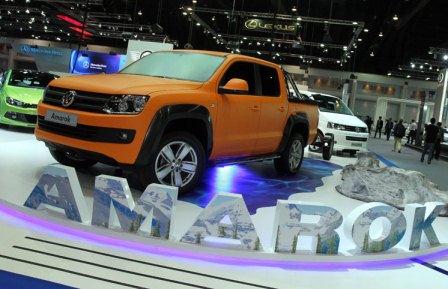
Volkswagen Amarok
The Amarok is the most expensive pickup truck sold in Thailand, retailing at approximately Bt1.8 million. It comes with a 2.0-liter Bi-Turbo TDI engine capable of producing 177hp and 420Nm, and is mated to an 8-speed ZF transmission. It also comes with the 4Motion all-wheel-drive system along with ABS brakes and Electronic Stability Programme.
MTM R8 Spyder
The beefed-up Audi R8 roadster has a 5.2-litre V-10 direct-injection engine that has been modified to increase power from 560 to 606hp, driving all wheels to accelerate the car from 0-100km/h in 3.7 secs and reaching a top speed of 325km/h.
RUF RT 35
The RUF RT 35 Anniversary commemorates the 35th anniversary of the German tuner. It is powered by a twin-turbo twin-intercooler 3.8-litre flat-six engine producing 630hp of max power and 833Nm of torque. It comes with 20-inch wheels (8.5 front and 11.0 rear).

Credit : Kingsley Wijayasinha The Nation

11.25.2555

Volkswagen's parents' convey 'Thailand Vehicle' vehicles at separate injection of a fight 'Grey' debut first new pickup.

Thailand Company Limited automotive importer and distributor of Volkswagen cars Swakopmund packages. Official in Thailand "Thailand Automotive Group" revealed that Swarovski and Volkswagen AG of Germany. Know the condition of the fiercely competitive car market in the country. The parent company is trying to help the Thailand Automotive competitively. Is funding to support the motor vehicles sold in Thailand today. By the motor during the 29 days from 29 November -10 December 2555 at Challenger, Muang Thong Thani, will deliver benefits for consumers to order or buy Volkswagen Car Swarovski Christmas Holiday SEA models (Scirocco. ) and GTI (GTI) will offer a discount for more than one hundred thousand units over the government to tax the car for the first car one hundred thousand baht.
tag