แสดงบทความที่มีป้ายกำกับ Crisis แสดงบทความทั้งหมด

12.29.2555

Korean Automakers Thrive in China as Japan Car Sales Drop


Hyundai Motor Co. (005380) and affiliate Kia Motors Corp. (000270) forecast sales in China will exceed their targets as South Korea’s two largest carmakers benefit from a wave of anti-Japan protests in the world’s largest vehicle market.
The two carmakers will probably sell more vehicles in 2012 than the 1.25 million they had projected, Seoul-based Hyundai Motor said in a statement yesterday. Combined deliveries rose to 127,827 units last month, or 9.5 percent higher than the previous record set a year earlier, it said.
Non-Japanese brands stand to gain as Chinese consumers shun products from Toyota Motor Corp. (7203) to Sony Corp. (6758) after a territorial dispute escalated last month, when Japan decided to purchase a group of islands claimed by both countries. JPMorgan Chase & Co. (JPM) economists warned last week the political row between Asia’s two largest economies will cause Japan’s gross domestic product to contract this quarter.
“Although the China sales results are definitely good news for Hyundai and Kia as a whole, the benefits from the anti-Japan movements aren’t likely to last long,” said Lee Sang Hyun, an analyst at NH Investment & Securities Co. (016420) “Also, Japanese automakers that resume production today will try to make up their losses.”
Production in China is typically shut down for the annual so-called Golden Week holiday that started Oct. 1 this year.
The China gains failed to impress investors as Hyundai Motor shares fell for a fourth day, dropping 2.1 percent to 237,500 won at the close in Seoul trading. Macquarie Group Ltd. (MQG) analysts wrote last week third-quarter deliveries worldwide at Hyundai Motor and Kia were about 4 percent lower than expected.

Tumbling Sales

Nissan Motor Co. (7201), which has the highest market share in China among Japanese carmakers, saw September sales fall about 35 percent, while Toyota plans to cut October production 50 percent from a year earlier, the Mainichi newspaper reported Oct. 6, without saying where it got the information.
Mazda Motor Corp. (7261) reported Oct. 4 deliveries in the country tumbled 35 percent to the lowest in 19 months, while Mitsubishi Motors Corp. (7211) said a day later that Chinese sales plunged 63 percent.
In September, traditionally a major shopping season in China, Hyundai Motor and Kia sales in the country were driven by the Langdong and K2 models, respectively, according to yesterday’s statement. Deliveries at Hyundai Motor increased 15 percent to 84,188 units, and climbed to 43,639 units from 43,508 units at Kia.
Hyundai Motor’s third Chinese plant, which opened earlier this year, may help the company increase production and sell more vehicles in China, though Kia won’t be able to expand much further because its plants in the country are already operating at full capacity, NH Investment’s Lee said.

GM Sales

Not all non-Japanese brands capitalized on the protests.General Motors Co. (GM) reported September sales rose 1.7 percent from a year earlier to 244,266 units, slowing from the 7.3 percent surge the previous month. Sales of Buicks declined 1.8 percent while those of Cadillacs fell 8.3 percent, GM said.
Japanese vehicle manufacturers cut output in China in August and officials at the companies said sales and production were poised to deteriorate in September amid the deepening territorial row which has become the worst diplomatic crisis between the two nations since 2005, when thousands of Chinese protested Japanese textbooks that downplayed wartime atrocities.
The dispute escalated when Japan said Sept. 11 that it would purchase the islands, known as Diaoyu in China and Senkaku in Japan, from a private owner.

Nissan, Mazda

Nissan expects anti-Japanese sentiment to hit September sales, Executive Vice President Takao Katagiri said on Oct. 5. The company will weigh the impact of the Chinese protests before deciding whether to revise its sales target there, Katagiri said.
Japan’s three largest automakers plan to cut production to half of normal levels in China, the Nikkei newspaper reported today.
Mazda, the first Japanese automaker to report China sales, said on Oct. 4 deliveries in China dropped to 13,258 vehicles, meaning the company didn’t even match its sales during the aftermath of last year’s tsunami in Japan and floods in Thailand. Mitsubishi’s Chinese sales last month were the lowest since at least April 2011, when the company changed the way it counts China deliveries, spokesman Kai Inada said on Oct. 5.

Credit by Bloomberg

11.04.2554

Thailand flooding crisis

      Thailand has been inundated with severe floods in its recent history and the recent inundation of floods in Thailand has not only had a major effect on local automotive production and supply chain disturbances but is also likely to have short term effect on regional and global supply of automotive parts and vehicle exports. Thailand is currently experiencing the worst flooding in the last 5 decades and the automotive sector, which has an annual production capacity of about 2 million units in 2010, has been one of the most affected industries. Besides the effects on the Thai auto market, there are also serious effects on the global supply chain as a large of automotive parts and vehicles are exported from the country. As shown in the map above (prepared by Frost & Sullivan), most of the heavy flooding is focused in the central province of Thailand with Ayutthaya and Pathumthani provinces that have automotive assemblers and parts suppliers, being the most affected regions. Honda’s assembly plant is located in Ayutthaya and it is the most affected carmaker occurring even with flood inundation within the assembly plant. All the other carmakers’ assembly locations are outside the flood affected regions such as Chachoengsao (Toyota and Isuzu), Samut Prakarn (Nissan and Toyota), Chonburi (Mitsubishi), and Rayong (Auto Alliance Thailand and GM). Honda has stopped its production for one week mainly because the plant is submerged with water while Toyota has stopped production for the one week mainly due to supply chain disruption in the Ayutthaya and Pathumthani provinces. Ford has resumed its passenger vehicle production after a stoppage but its pick-up vehicle production is still suspended. GeneralMotors (which makes Chevrolet vehicles) is the least affected carmaker, mainly due to its plant location and its supplier base in southeastern Thailand which is outside the flood-affected regions GM vehicle plant and its new powertrain factory (right), both in Rayong in the southeast area of Thailand, have escaped the floods and can continue production but are susceptible to parts shortages if they are dependent on suppliers who are in the flooded areas and have had to stop operations The severe effect on autoparts makers has caused a serious disruption in the supply chain structure. This situation has had a cascading effect on automotive assembly and production in Thailand. Almost 10% of total auto parts for local production come from flood-affected regions. Toyota, Auto Alliance Thailand, Mitsubishi Motors, Nissan are all dependent on autoparts makers which have factories in the flood-affected areas; in the Ayutthaya and Pathumthani provinces, there are some 40 suppliers. Just one part not supplied to the assembly line and the car cannot be completed at all The unprecedented situation is likely to affect automotive assembly in the short term. The production halt might continue for some weeks depending on the severity of the flooding. Honda is likely to have a production loss of about 10,000-15,000 units with the closure of its plant for up to 5 weeks. Toyota and Isuzu are likely to lose the next 2-3 weeks of production due to shortage of parts supply with loss of estimated production volume to be approximately 30,000 - 35,000 units and 10,000-15,000 units, respectively. Frost & Sullivan estimate the overall production volume loss of approximately 80,000 - 100,000 units for all carmakers in Thailand if they lose the next 2 - 3 weeks of production. However, they are likely to recover this production loss by ramping up their production for the next 2 months by increasing the working hours and running the plants at full capacity. To compensate for the loss of production in Thai assembly plants, the carmakers are make a short-term production shift to other ASEAN countries such as Indonesia and Malaysia where they have assembly operations for certain models as well. For example, Honda also assembles the Jazz in Indonesia so it could transfer production there for a while. Almost 900,000 units vehicles representing 54% - 55% of total vehicles assembled in Thailand were exported in 2010. The main export regions were Australia, New-Zealand, Europe, the Middle East, Mexico, South Africa and Brunei. The vehicle models presently exported are vehicles such as Honda’s Jazz, Civic, City, Accord and Toyota’s Hilux. Disruptions in the supply of parts have been the main reason for many carmakers’ plants having to stop their assembly lines. Some of the factors that are likely to be considered by the carmakers in future are: Honda's factory in Indonesia also produces the Jazz (including stamped parts) and could take over production from the Thai plant in the short-term • Increase the stockpile in terms of parts and revisit the process of JIT (Just In Time) so that there is enough stock at the vehicle assembly plant for at least a month if there are any disruptions related to autoparts supply; • Multi-sourcing strategy that involves not only sourcing parts from different suppliers but from different regions that will have a lower impact if this situation arises again; • Climatic de-risking of the supply chain that involves carmakers’ investments at geographic locations that are least impacted due to natural disasters. The Japanese carmakers in India, especially Honda, have already started increasing their localization content (80% - 90%) and the remaining autoparts are likely to be supplied either from Japan or other ASEAN countries. The automotive production in Thailand will be affected in the near-term due to the lack of auto parts supply as a result of the floods but is not likely to have a medium to long-term effect on Thailand as an automotive production hub in the region.

6.19.2554

Honda sees 63% drop in earnings

Just days after its rival, Toyota, projected it would see a huge plunge in profits as the result of the March 11 Japanese earthquake, Honda Motor Co. says it also will take a devastating hit to its bottom line, with earnings for the current fiscal year likely to plunge by 63.5%.
Honda – like Toyota – delayed its forecast for the fiscal year running through March 2012 while it assessed the impact of the earthquake and subsequent tsunami, which shut down most of its home market production for a month.
News You Can Use!
Honda now expects to have most of its factories back up to speed sooner than initially anticipated, but several key operations, including the plants producing the critical new 2012 Civic, will be operating below capacity until autumn.
Honda anticipates the current fiscal year will see profits of 195 billion yen ($2.4 billion), down by nearly two-thirds from the 534 billion yen recorded during the fiscal year that ended last March 31.
The maker puts most of the blame on the March 11 natural disaster, which not only impacted production but also ran up billions of yen in unanticipated repairs to Honda plants and other facilities. The company was the only Japanese automaker to report an on-site fatality during the earthquake, a worker at the Tochigi technical center killed when a wall collapsed upon him.
“Honda was deeply hurt” because it operates so lean it couldn’t make up for losses suffered during the disaster, analyst Koji Endo, Tokyo’s Advanced Research Japan, told the Associated Press. “This is going to take awhile.”
Other factors that will negatively impact Honda’s projected earnings include rising raw materials costs as well as the weak U.S. dollar – though the maker’s large production base in the States helps minimize the effects of lopsided exchange rates.

(Toyota, with a larger home market production base, is being especially hard hit by the weak dollar. Click Here for more.)
But the March disaster has curtailed Honda’s production at both home and foreign-based plants, Honda predicting it will see global sales slip to 3.3 million for the fiscal year as a result – a 6% decline from the prior year’s 3.51 million. Revenues, meanwhile, are projected to dip 7.1%, to 8.3 trillion yen, or $104 billion.
Like Toyota, Honda plans to begin making up some of its lost production in the months ahead. But the timing of the disaster will make it difficult to recover completely. Ongoing product shortages have meant that Honda could not take full advantage of shifting consumer sentiments – especially in the U.S. – triggered by soaring fuel prices.
The maker was short of a number of its smaller, more energy-efficient models, including the Fit and its various hybrid-electric vehicles. It also lost momentum with the critical launch of the next-generation Civic, traditionally one of the best-selling models in the compact segment.
Toyota last week projected its fiscal year profits would fall by a third, to 280 billion yen, or $3.5 billion. Nissan has also delayed its earnings forecast but is expected to release that report prior to the company’s annual shareholders meeting on June 29.
Honda Forecasts 63% Drop in Profits

4.10.2554

Auto industry insists Thai jobs safe after Japan crisis

Employers in the automobile industry say they will not lay off workers and are trying to ensure they survive the repercussions from the situation in Japan. Yongyuth Mentaphao, president of the Federation of Automotive Labour Unions, said the disaster has affected the auto industry in Thailand, a major base for car parts production, as certain parts have to be imported from Japan. Plants in Japan could not produce car parts because of limitations imposed on electricity usage in Japan after last month's earthquake and tsunami and the continuing nuclear crisis. This has affected the assembly line and workers in the car industry in Thailand, Mr Yongyuth said. There are about 500,000 workers in the Thai auto industry. He said these employees are not being offered overtime, but there are no plans to lay them off. He believed Japan will recover from the situation soon, and when the situation picks up, production capacity is expected to increase two to three-fold because a lot of orders have been placed. The orders have not been cancelled despite the crisis, Mr Yongyuth said. Chalee Loysoong, president of the Confederation of Thai Electrical Appliance, Electronics, Automobile and Metal Workers, said the confederation has asked employers in the car parts industry not to dismiss workers. Once the situation returns to normal, the industry will be hit by staff shortages and it will be difficult to find skilled and experienced workers, he said. Amporn Nitisiri, director-general of the Labour Protection and Welfare Department, said about 300 factories in the car parts and car assembly industry and more than 100,000 workers have felt the effects of the crisis in Japan. Some have been laid off temporarily and received only 75% of their compensation payments, Ms Amporn said.

3.20.2554

Japan car makers's situation after 10 days earthquake

Japanese auto makers, led by Toyota Motor Co, are struggling to restart production amid a shortage of parts and workers, and must now worry about a profit-sapping surge in the yen after Japan's biggest earthquake. Articles Yen rise may cause bigger damage to Toyota profit than quake Toyota, the world's No.1 automaker, said on Wednesday it will keep its 12 local assembly plants shut for a further week at least. The plants have been closed since Friday's 9.0 magnitude earthquake unleashed a tsunami which killed at least 10,000 and damaged a nuclear plant north of Tokyo. Toyota's largest domestic rival, Nissan Motor , said it would restart two plants on Thursday and Friday, but production beyond that remained uncertain. Other plants would take longer to get back on line. No.3 Honda Motor has also idled plants and on Wednesday reiterated its plans to suspend all production in Japan until at least Sunday. Analysts said if production starts within a couple of week, excess capacity resulting from the dip in global car sales after the financial crisis of 2008 means the automakers may be able to make up for lost output. But with the Japanese currency nearing a record high, the profit margin on their Japan-made cars will shrink. "The direction of the Japanese yen over the next three to six months as a result of this catastrophe will also affect the profitability if Japanese automakers," Fitch Ratings said in a report. The dollar has fallen 3 percent against the yen since the disaster and is now close to its all-time low. The dollar traded around 80.8 yen on Wednesday, just a yen away from 79.75 in 1995. Traders and investors are watching for signs of repatriation by Japanese investors and companies because after the Kobe earthquake in 1995, the yen surged to an all-time high against the dollar based on similar flows. So far though most traders have not seen repatriation taking place. PLANTS REMAIN IDLE Toyota still builds 38 percent of its vehicles in Japan, making it the most exposed to the crisis and the resulting rise in the value of the yen. It ships more than half of its domestic output to overseas markets. Nissan produces 24 percent of output in Japan while the figure for Honda is just 22 percent. Toyota said on Wednesday that it would restart some parts production on Thursday at seven small plants near its home base in Toyota city. The same plants from Monday will also begin shipping car components for assembly overseas. Yet, until it can restart its main factories lost production, which over the past three days has risen to about 40,000 vehicles will mount. Elsewhere, it has cut over-time production at plants in Thailand and North America while it assesses the impact on supplies. Amid a general rebound in stocks Wednesday, Toyota closed up 9 percent, with Nissan up 6 percent and Honda 3.9 percent higher. Goldman has estimated the profit impact of stopping production for one day would be about 6 billion yen ($74 million) for Toyota and 2 billion yen for Honda and Nissan. Koji Endo, managing director of Advanced Research Japan in Tokyo, said plants were likely to start resuming production next week and should be back up to full capacity by the end of the month. "Even if those companies lose say 100,00, 150,000 units until the end of March I think they can recapture that lost opportunity from April," he said Auto production in Japan is concentrated in central of and southern regions, with few big plants in the worst affected areas. Plant shutdowns could start affecting global automakers and parts suppliers within two weeks due to the integration of the industry. Hyundai Motors in neighboring South Korea said it doesn't expect the Japanese auto industry's woe to affect it. "We do not see a major impact from Japan's earthquake because we have secured an inventory of one to two months," a spokeswoman said. Those Japanese parts makers that do ship products to Hyundai were not directly affected by the earthquake, she added Hyundai and affiliate Kia Motors will be less affected by parts supply disruption from Japan than their U.S. and European peers because they source most of their components from South Korean firms, Mo Se-jun, an analyst Hana Daewoo Securities, said. "It remains to be seen whether South Korean carmakers will benefit from the disaster as Japanese carmakers have a two-month car inventory," Mo said.

2.06.2554

Honda doubling shifts in Ayutthaya


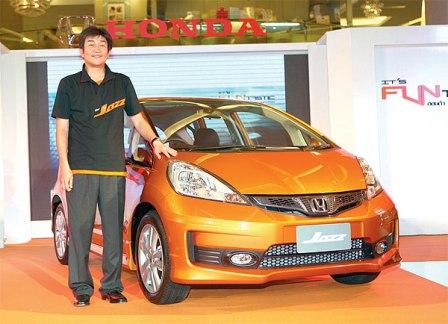
The Japanese carmaker plans to raise local sales by 27.2% from last year to 145,000 units including the Brio, an eco-car that will debut in the first quarter. Honda predicts the overall automobile market will grow at a slower pace to 850,000 units this year from actual sales of 803,000 last year. However, president Atsushi Fujimoto said the company's export volume would remain unchanged at 60,000 units, as the stronger baht is making exports less profitable. Australia and Japan are the local Honda unit's main export markets. To meet the combined sales forecast of 205,000 units, Honda will add a second work shift during the first half of this year to raise annual production from the present level of 120,000 to 130,000 units. The Ayutthaya plant has a maximum annual capacity of 240,000 units. This year's expected higher sales will be contributed in part by the Brio eco-car, the City, the Jazz and the Civic. Other models include the Accord and the CR-V, as well as the Freed mini-multipurpose vehicle, which is imported from Indonesia under the Asean Free Trade Area. Honda does not make pickup trucks, the most popular vehicles sold in Thailand. Mr Fujimoto also reaffirmed that Honda has no plans at the moment to introduce hybrid models to match Toyota, which now markets two locally - the Camry and the Prius. He is not yet certain whether petrol-electric models can do well locally, as sales of at least one of the Toyota hybrids have begun to flag. Honda exports all of its hybrid Insight, Civic and Accord models produced here. "We will see further whether hybrid models are actually accepted by local consumers and if so, identify which group to target first," said Mr Fujimoto. He also threw his support behind the government's move to restructure vehicle excise tax rates to take better account of reduced carbon dioxide emissions and high fuel efficiency. The proposed new structure is more appropriate than the existing one based on engine capacity, said Mr Fujimoto. Meanwhile, Honda yesterday introduced the new Jazz, which features a refreshing facelift and upgraded features to reinforce the company's leadership in the five-door subcompact category. The new Jazz offers dual airbags and an anti-lock braking system on all models, making it the first subcompact to offer enhanced safety features for both driver and occupants. In Thailand, 135,375 Jazz units have been sold since it first debuted in 2003. It comes in three versions priced from 590,000 to 715,000 baht, all of them equipped with a 1.5-litre engine.